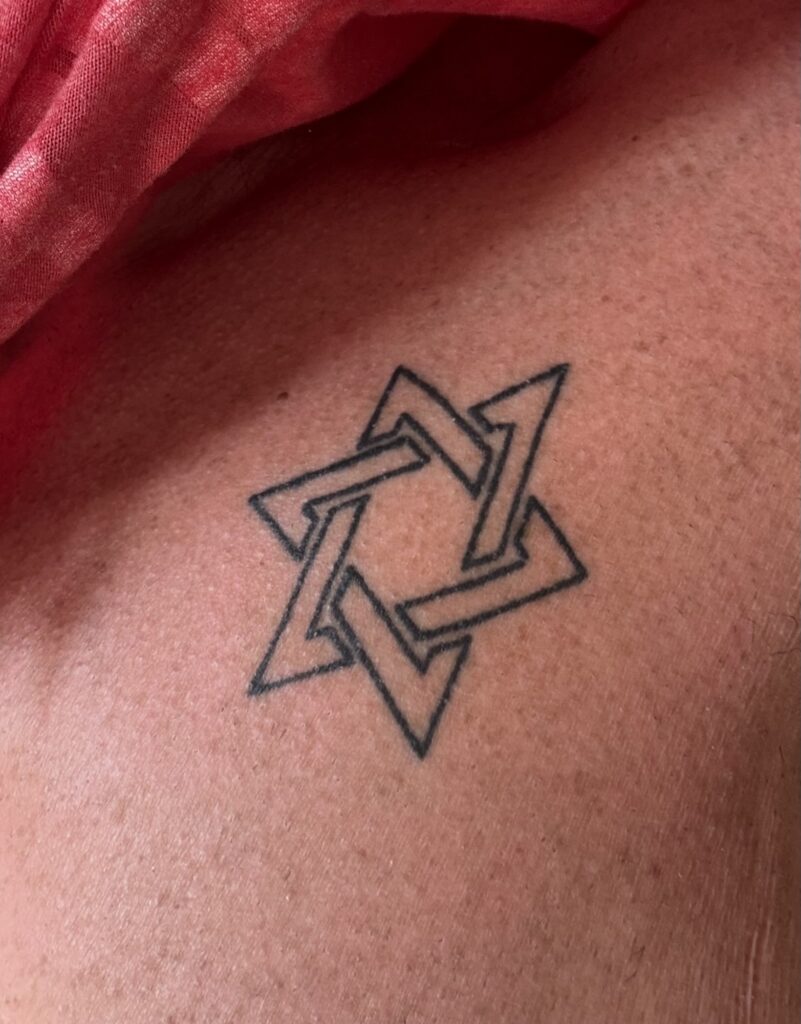
For centuries, tattoos have occupied a complicated and uneasy space in Judaism. Traditionally considered taboo, they’ve stirred debate, discomfort, and fear. The old myth that Jews with tattoos cannot be buried in a Jewish cemetery has long been debunked, but its shadow still lingers in the communal imagination—whispered at shiva, repeated at summer camps, and passed from generation to generation like spiritual folklore.
As a rabbi, I’ve spent years guiding others through their own religious journeys—balancing the weight of tradition with the lived reality of human complexity. But I never imagined that I would end up getting a tattoo. I certainly never imagined it would mean so much.
This wasn’t a youthful rebellion or a midlife impulse. It was something deeper: a need to reclaim agency over my own body, my own narrative, my own soul. I needed to affirm that I am not merely a vessel for Jewish tradition—I am a living part of it. And living Judaism, I’ve come to believe, demands not blind obedience but courageous ownership.
No one owns me—not culture, not commentary, not even fear masquerading as fidelity.
Before making the decision, I turned to halakhah. I studied Rabbi Alan Lucas’s teshuvah on tattooing, which takes seriously both the classical prohibitions and the modern psychological motivations behind tattoos. I spoke with colleagues I trust. I reflected deeply on my own motives—not to justify, but to understand. Could this act, so often seen as transgressive, become a sacred form of expression?
Eventually, the answer for me was yes.
I now carry four tattoos:
- On my left forearm: “Be curious, not judgmental,” from Ted Lasso—a daily reminder of the posture I strive to take into every interaction.
- On my right forearm: a quote attributed to President Theodore Roosevelt—“If he fails, at least he fails while daring greatly”—a challenge to live with courage, not caution.
- On my chest, over my heart: a Star of David—not as a nationalist symbol or a political claim, but as an emblem of love, memory, and belonging.
- On my right bicep: the Hebrew of Psalm 121—“I lift my eyes to the mountains…”—a prayer that has sustained me through long nights of fear, fatigue, and doubt.
Each one was chosen with care. None include God’s name—not in Hebrew, not in English, not in any form. That line was never blurry. Reverence requires boundaries. But those boundaries do not cancel out the possibility of meaning—they shape it.
The psychology of tattooing is often about memory, identity, and transformation. For me, it became an act of integration. A way of bringing my internal life—my values, wounds, prayers, and hopes—to the surface. These aren’t acts of defiance. They’re acts of affirmation. They declare that my body is not a barrier to holiness, but a participant in it.
Judaism teaches that our lives are texts. We write them in deeds, in words, in time. I’ve simply chosen to inscribe parts of mine on my skin.
Of course, I wrestled with the consequences. Would people see me differently? Would some stop trusting me as a rabbi? Would I be seen as less serious, less grounded, less “appropriate”?
But in the end, I realized: if my credibility depends on hiding the parts of myself that are most honest, then it’s not credibility I want. Leadership rooted in performance is not leadership at all.
Spiritual life—real spiritual life—demands authenticity. It asks us to show up not as polished symbols, but as people. People in process. People with contradictions. People who choose, stumble, reflect, and try again. This tattoo—and the others I’ve added—are not symbols of a break from Judaism, but a deepening of it.
They say that Jews don’t write our truths on our skin. We write them in books. We write them in law, in memory, in ritual.
But sometimes, the book is not enough. Sometimes the body becomes the scroll.
Some will disagree with my choice. I expect that. Judaism has always thrived on disagreement—on argument for the sake of heaven, on sacred pushback. All I ask is that if you have questions, bring them to me. Not about me. Let us model the best of our tradition: honest conversation, deep listening, and mutual respect.
In the end, these tattoos do not pull me away from Judaism or from community—they bind me more deeply to both. They remind me that Jewish life is not just inherited—it is created. Not just preserved—but chosen.
This is the permanent ink of a temporary life.
And I choose to wear it with gratitude, with intention, and with an ever-deepening commitment to live my Judaism—not perfectly, but fully