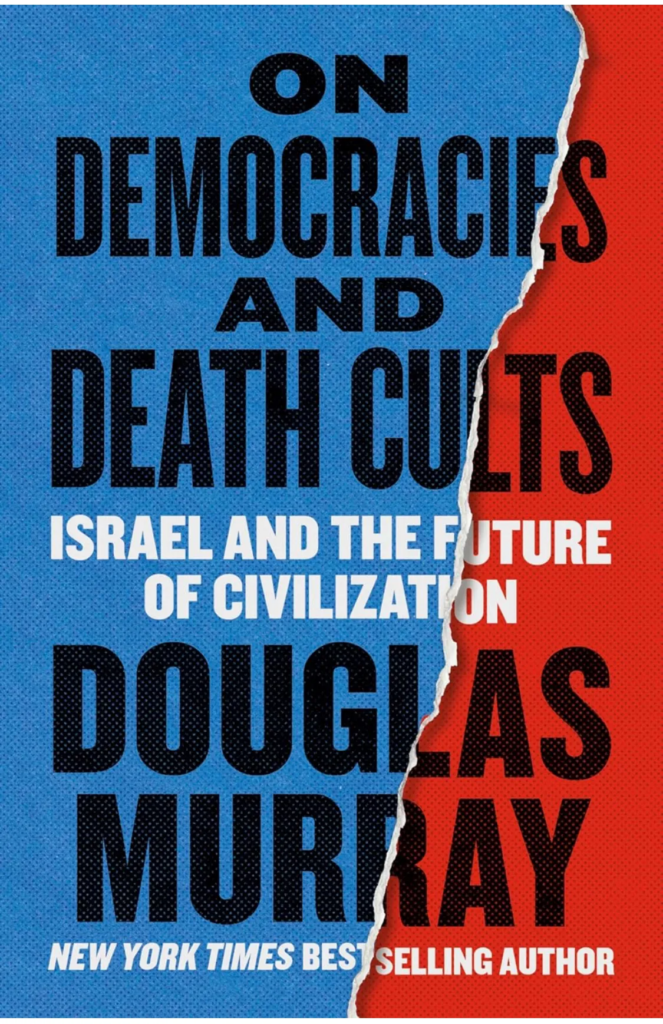
There is something unnerving about being better defended by outsiders than by one’s own kin. That is how I feel reading Douglas Murray’s On Democracy and Death Cults—a tight, fierce little volume that ought to be read with both reverence and discomfort. Reverence, because in a year of historic abandonment, Murray has emerged as the single most articulate and courageous defender of the Jewish people in the West. Discomfort, because he is not Jewish. He is what many of us used to call “a righteous gentile”—but there is nothing quiet or meek about his righteousness.
Reading Murray is not like reading Hasbara. It is not defensive, apologetic, or designed for debate club points. His writing is moral, sharp, and unrelenting. On Democracy and Death Cults is not a book about Jews, per se, but the Jewish question haunts every page—what happens when the West, with all its institutions and enlightenment ideals, flirts with nihilism and forgets what it is for? What happens when the nation that taught the world about covenant and ethics becomes the scapegoat for those who would burn it all down?
Murray’s answer is stark: democracy will not survive if it does not learn to recognize and fight death cults. The great tragedy, he writes, is not only that Western democracies are being infiltrated by ideologies that celebrate death, but that they are ashamed to defend themselves against them. Hamas doesn’t hide its ideology—Murray cites it clearly: the glorification of martyrdom, the sanctification of child murder, the use of hospitals and schools as shields. What’s shocking is not that Hamas exists. What’s shocking is that so many Western academics, journalists, and “activists” have lined up to explain why Hamas is misunderstood, or even admirable. Murray calls this out with eloquent fury.
But Murray’s book is not merely a political polemic. It is, in a deeper sense, a meditation on moral asymmetry. He writes from a place of love—for civilization, for life, for meaning. And that, I think, is what makes his voice so resonant to Jews right now. Because Jews are not simply asking, “Who will protect us?” We are asking, “Who still believes in life?” Who still believes that a mother shielding her children from a grenade is a saint, not a settler? Who still believes that music festivals are better than martyrdom?
This is not just about Israel. It is about what it means to be human in a world that sometimes seems bored by humanity.
Reading Murray, I found myself thinking of the prophets—particularly Jeremiah. Not because Murray offers consolation (he doesn’t), but because he sees what others refuse to see. Jeremiah was not beloved in his time. He was accused of sedition, pessimism, and moral absolutism. But history vindicated him. I suspect Murray will be similarly remembered.
And yet, this raises a painful irony for me as a rabbi. Why is it that so many of our Jewish intellectuals, university presidents, and progressive voices have fled the moral field? Why are we being defended more passionately by a British atheist conservative than by Jewish tenured professors? Where are the descendants of Heschel? Where are the heirs of Buber, of Arendt, of Lévinas?
There is a kind of derangement in the academy, a desire to show moral sophistication by expressing “nuance” when confronted with evil. Murray skewers this impulse. He names the cowardice that dresses itself in complexity. He quotes philosophers, but he also tells stories—of Jewish children hiding, of terrorists celebrating, of rallies where mobs chant “gas the Jews” while holding signs that say “free Palestine.” He dares to say what many Jews are still whispering: we are in a spiritual crisis, and the West’s moral compass is spinning.
The book is not without its provocations. Murray is unafraid to name Islamism as the ideological threat it is, and in so doing, he violates the great taboo of Western liberal discourse. He is not interested in saying “both sides.” He is interested in defending life. That clarity, to some, will seem simplistic. But to those of us who have buried friends and counseled grieving parents this year, clarity is not a luxury—it is a necessity.
Still, I do not read Murray uncritically. He is a gifted polemicist, which sometimes means he flattens nuance for the sake of punch. His treatment of religion is respectful but utilitarian—he sees Judaism and Christianity as civilizational anchors, not as revealed paths. For a rabbi, this leaves something to be desired. But perhaps that is precisely the point: Murray is not trying to be our theologian. He is trying to be our shield.
And we need shields.
We need people who will stand in the streets and say what too many Jews have been too scared to say: Israel is not a colonial project. October 7 was not a “cycle of violence.” Gaza is not Auschwitz. Western institutions that give Hamas sympathizers a platform have betrayed their own founding values.
The Jewish tradition teaches that sometimes the stranger sees what the insider cannot. Balaam, the non-Israelite prophet, saw the tents of Jacob and blessed them. Cyrus, the Persian king, rebuilt the Temple. And in our own day, Douglas Murray has emerged as a strangely prophetic voice—not because he speaks for Jews, but because he refuses to abandon them.
It is a bitter gift, to be so fiercely defended by a gentile while being so feebly supported by our own. But it is a gift nonetheless.
I don’t know if Douglas Murray believes in God. But I believe that God is using Douglas Murray.
And for that, I am deeply, fiercely grateful.